Persistent Identity: The Missing Layer in Generative Image Models
Image models can build a scene and follow a complex instruction. What they still get wrong is who is in the picture. We built a benchmark to measure it.
A short version of our technical report, Persistent Identity Preservation in Generative Image Models: A Benchmark and Evaluation System (arXiv:2609.04151).
Today’s image models can build a scene, follow a complicated instruction, and edit a photo with surgical precision. What they still get wrong, surprisingly often, is who is in the picture. Ask for a new pose, a new expression, through multiple iterative edits, and the person in the output quietly turns into someone different.
We built a benchmark to measure exactly that, and used it to compare three very different ideas about where a subject’s identity should live.
Three places identity can live
In the context. Closed models such as GPT-Image-2, GPT-Image-2.5, NB2, Reve 2.1 and Seedream 5 Pro take reference photos alongside the prompt and infer the identity fresh on every request. Nothing to train, but the model has to re-derive the person each time from whatever it’s shown.
In the model. Open-weight models (FLUX.2, Ideogram 4, FireRed) can be personalized by training a per-subject LoRA. Identity becomes tied to that particular model, so moving to another foundation model generally means adapting or training it again.
In a persistent layer. Phota Identity trains a subject profile once and keeps it outside any generative model. The same profile then builds on interchangeable backends, and we evaluate it on top of GPT-Image-2, GPT-Image-2.5 and NB2.
The benchmark
We evaluate roughly 300 subject profiles across a deliberately challenging set of subject-centric generation, editing, and restoration tasks, spanning both single- and multi-subject settings. The benchmark stress-tests identity under increasingly challenging conditions, from appearance modifications and new poses to iterative edits, varying face scales, degraded photos, and multiple people in the same scene.
We jointly evaluate identity preservation and task performance across three separate dimensions: identity preservation, instruction following, and image quality. An output that preserves identity by simply refusing to make the requested edit isn’t successful, and neither is one that follows the instruction and produces a great image but no longer looks like the intended person.
Result 1: persistent identity leads across the benchmark
Across generation, editing, and restoration, persistent identity achieves the highest mean identity similarity among the evaluated methods.
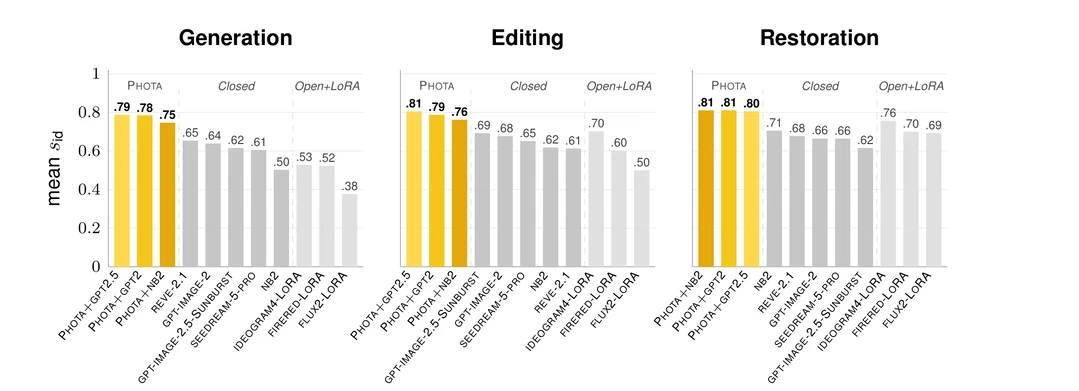
Fig 1. Mean identity similarity by method across generation, editing, and restoration. Within each task, methods are grouped as persistent identity, in-context, and model-specific (LoRA).
In-context foundation models retain strong native generation and editing capabilities but can drift in identity, especially when the subject must be synthesized anew. Per-subject LoRAs can strengthen identity conditioning, but results are more variable across models and tasks.
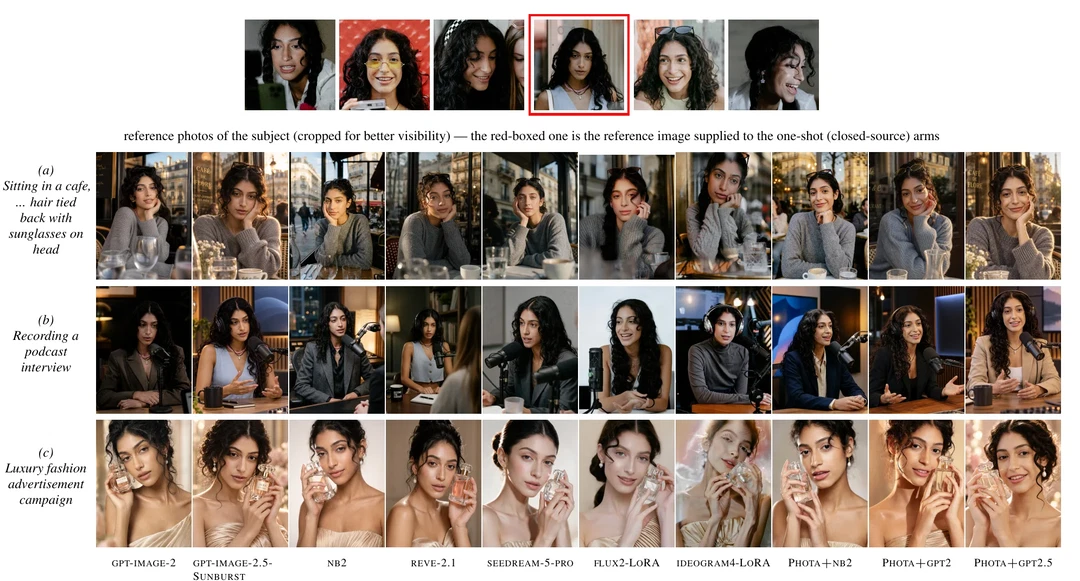
Fig 2. Qualitative comparison of subject-driven generation across distinct use cases: a cafe portrait, a podcast interview, and a fashion campaign. Columns are ordered by paradigm: in-context (GPT-Image-2, GPT-Image-2.5-Sunburst, NB2, Reve-2.1, Seedream-5-Pro), model-specific LoRA (FLUX2-LoRA, Ideogram4-LoRA), and persistent identity (Phota+NB2, Phota+GPT2, Phota+GPT2.5). Reference images of the subject appear along the top, and the red box indicates the reference provided to the in-context models. In-context models maintain high visual quality but exhibit greater identity drift, while LoRA improves subject resemblance at the expense of image quality. Persistent identity preserves subject identity more consistently while retaining the visual quality of the underlying foundation model.
The identity lift is not simply the result of a stronger base model. With the same base model, adding persistent identity improves identity preservation across generation, editing, and restoration, by up to 49%.
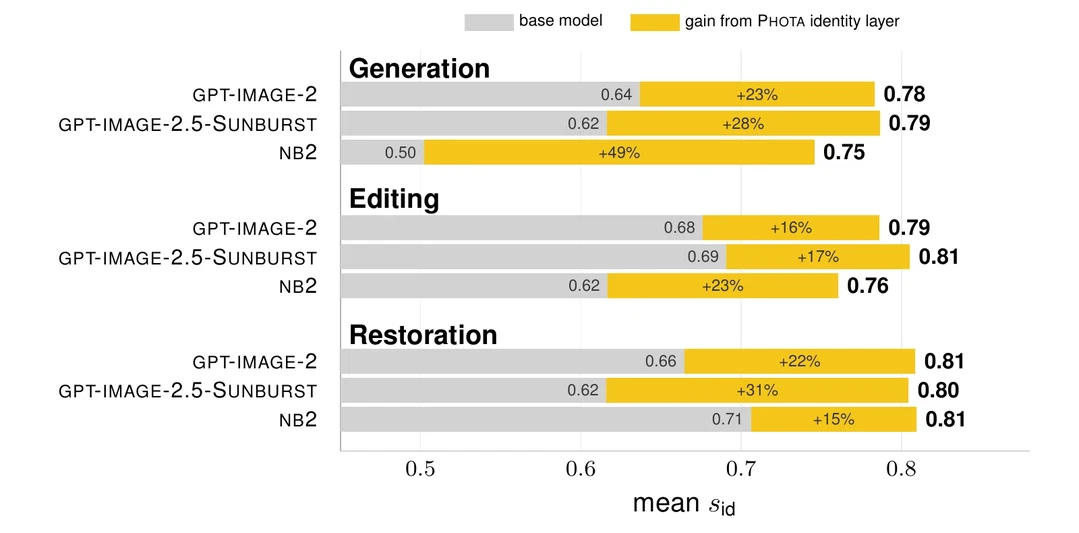
Fig 3. Mean identity similarity for three foundation models with and without the persistent identity layer, across generation, editing, and restoration. The layer is applied without modifying the underlying model.
Importantly, these gains come while maintaining comparable prompt following and perceptual image quality.
Result 2: the gap widens under stress
Averages hide the interesting part. We designed the task suite so that identity gets progressively harder to hold on to: smaller faces, heavier degradation, more editing rounds, more people in the frame.
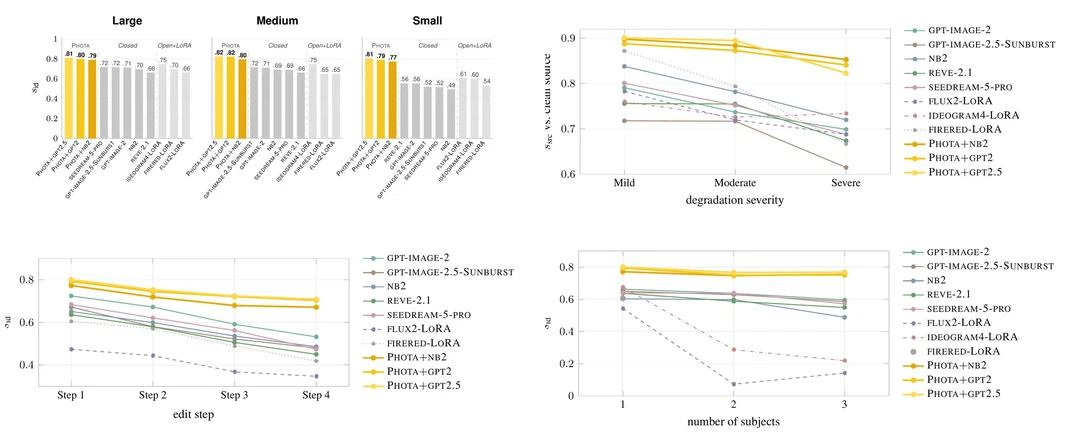
Fig 4. Identity similarity under four stress axes: subject face scale, degradation severity, successive editing rounds, and number of subjects. Identity preservation degrades for every paradigm as conditions become more demanding, and degrades most slowly for persistent identity.
Across these settings, identity preservation degrades as the task gets harder, but much more slowly with persistent identity. The advantage becomes especially pronounced under limited visual evidence, repeated transformations, and multi-subject settings, where identity drift compounds.
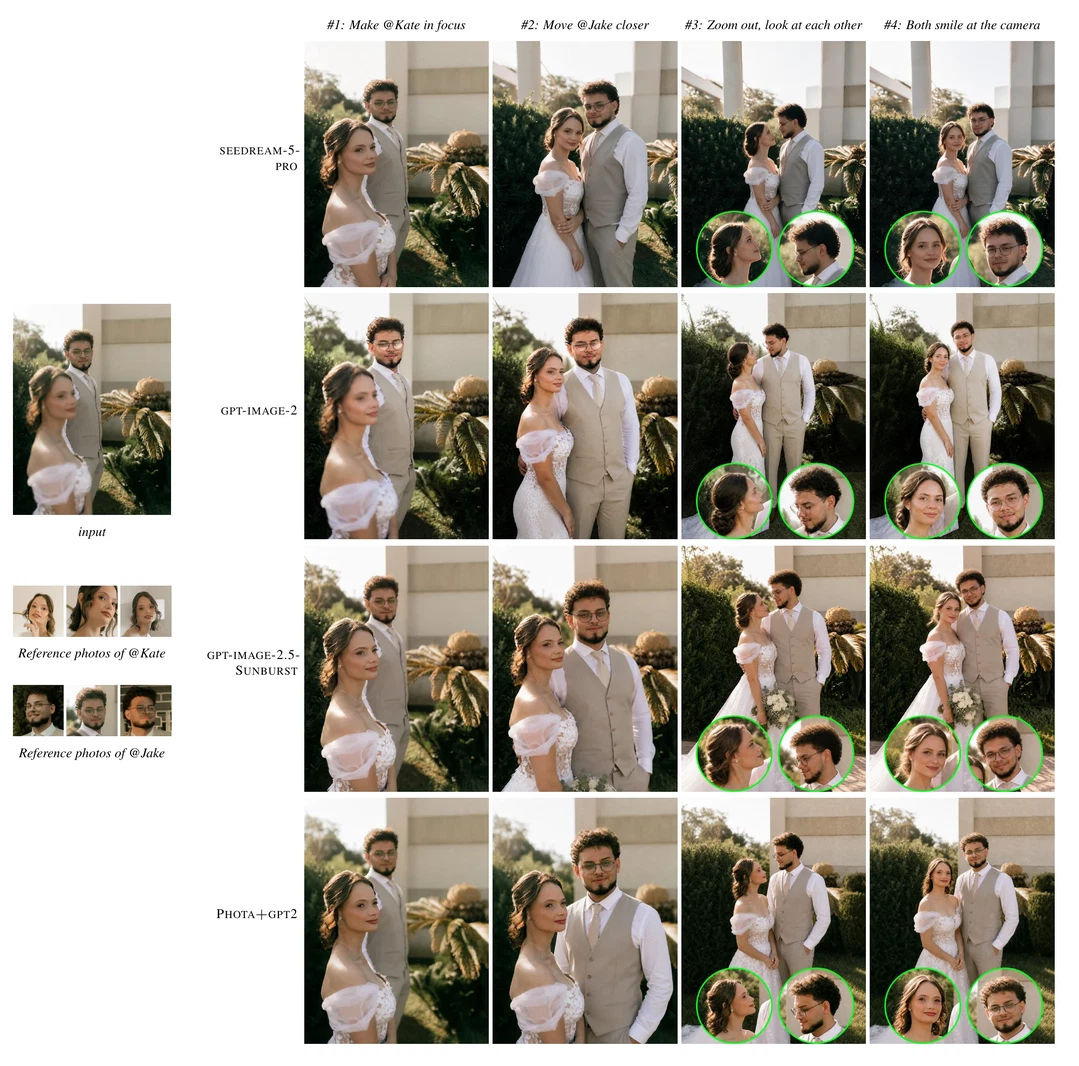
Fig 5. Qualitative comparison of iterative subject-driven editing over successive rounds, where each column applies the next instruction to the preceding output. Baseline methods execute each instruction, but identity-relevant deviations accumulate across rounds and the depicted subjects drift progressively from their enrolled identities. Persistent identity maintains both subjects throughout the editing trajectory.
Result 3: people who know the subject agree
Face-embedding similarity is a proxy. The real judge of likeness is someone who knows the person, so our human study uses only the subjects themselves and people who know them personally, comparing blinded output pairs on identity, instruction following and quality together.
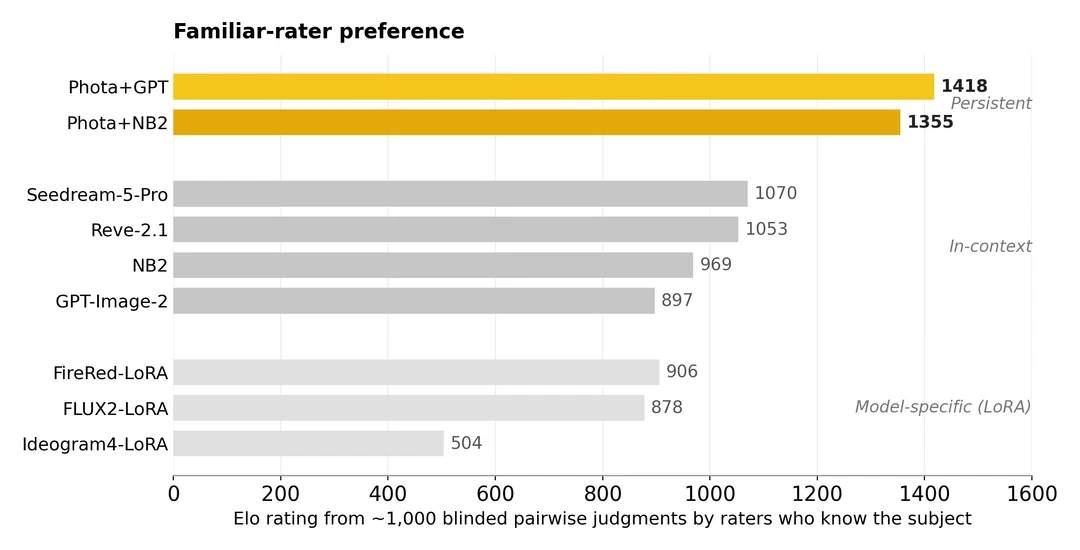
Fig 6. Elo ratings from the familiar-identity preference study, in which raters judged only subjects they know personally. Methods are grouped as persistent identity, in-context, and model-specific (LoRA).
Across roughly 1,000 pairwise judgments, both Phota variants rank well above every in-context and LoRA baseline.
What we take from this
Identity does not simply fall out of a more capable image model. Stronger generation and editing didn’t translate into stronger identity fidelity in our measurements, and the failures cluster in the situations that real workflows are made of: repeated edits, group photos, small faces, old degraded pictures. Treating identity as persistent subject knowledge that composes with, rather than lives inside, the generative model recovers most of that loss, and does so for whichever backend is underneath.
The full technical report covers the metric design (including match-rate curves rather than a single threshold), per-task breakdowns, the restoration and multi-subject results in detail, and the limitations of face-based identity measurement for bodies, pets and stylized subjects.
For background on the problem itself, see what identity preservation means and why it is hard. For results laid out side by side against foundation models and LoRA, see the comparison.